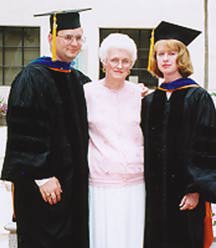
Congratulations, you have done it!
The Admissions Committee will appoint a temporary advisor. The Option Representative will inform the student of that choice, usually during the spring prior to the student's first registration. This advisor is temporary in the sense that either the student or the advisor may inform the Option Representative at any time that the appointment of another faculty member would be more appropriate to the student's interests.
During the week before first registering for graduate study the student should consult with the temporary advisor and other faculty members to plan the program of coursework. The core courses for the Ph.D. degree are:
1. MS 131, MS 132, MS 133
Structure and Bonding in Materials,
Diffraction and Structure of Materials,
Kinetic Processes in Materials.
2. APh 105a or ChE 165, APh 105b or ChE/Ch 164, MS 105
Thermodynamics, Statistical Mechanics, Phase Transformations.
3. Two quarters of courses focused on specific materials,
such as:
APh 114a,b Solid State Physics;
Ch/ChE 147,
ChE/Ch 148 Polymer Synthesis and Physics;
Ge 114, Ge 214, Ge 260 Mineralogy, Spectroscopy of Minerals,
Physics of Earth Materials.
4. Two quarters of courses focused on internal interactions
in materials, such as:
Ph 125 a,b, Ch 125 a,b
Quantum Mechanics;
Ae/AM/CE 102 a,b Mechanics of Structures and Solids;
Ae/AM 160 a,b Continuum Mechanics;
Ch 120 b Nature of the Chemical Bond, Ch 121 a,b Materials and
Molecular Simulations.
5. 18 units of courses comprising either the third terms of the sequences taken in 3 and 4 above, or other courses appropriate for the student's research interests.
6. Mathematics at the level expected of research in the student's field. This may be satisfied by the courses ACM 95/100 abc, or ACM 101, 102 ab, ACM 110, 111, 112, or Ph 129 abc, or may be waived at the dis cretion of the student's adviser and option representative.
7. MS 110 abc (3 units), seminar.
The M.S. degree requires a total of 135 units as specified in the above list, with the exception that up to 27 units of M.S. 200 (research) may be substituted for any courses in the list. (This exception should facilitate completing the M.S. degree in about one year.)
Any of the above courses could have been taken in a previous degree program at the Institute. If an equivalent course was taken elsewhere, the student may prove competence in the subject material by a short oral examination administered by the instructor of that course. If the student believes he has completed a more substantial course elsewhere, he may petition the Option Representative and the Dean of Graduate Studies to remove the course from his list of requirements.
The agreed-upon candidacy program is entered on the record of study, approved by the advisor and Option Representative, and returned to the Option Representative prior to or at the first registration for the Ph.D. degree.
At first registration for the Ph.D. degree, the advisor will check the record of study and approve the courses to be taken that term. The student then will meet with the Option Representative to obtain his approval.
The student should choose an advisor sometime during the first year of graduate study. It is preferable for the student to make this decision early, but it is an important decision that should be made with care. The adviser-advisee relationship is an important one, and requires effort by both parties to make it work well.
Some students are admitted to graduate study with financial support from a specific faculty member who serves as their advisor when they arrive. These offers of support were made after careful consideration of the student's stated interests and the resources of the faculty, but this assignment of advisor need not be permanent. It is expected, however, that if the student wishes to change his advisor, he should do this as soon as possible.
During the third term of the first year of Ph.D. study, each student who will continue study the following year should confer with his or her advisor and Option Representative regarding:
1. Possible modifications in the program of courses remaining to be taken during the next year.
2. Research during the coming summer.
3. Consideration of an appropriate time to take the candidacy examination.
The candidacy examination is a comprehensive oral examination on the major field and is up to three hours in length. The emphasis is on adequate knowledge of the field, rather than of specific courses. In fact, the major candidacy courses need not be completed prior to taking the examination. The student should consult with his or her advisor and the Option Representative to determine when his or her preparation will be sufficient for the candidacy examination.
One to two months before the expected examination date, the student should obtain a Ph.D. Candidacy form from the Graduate Office. The student and the advisor will choose members of the examining committee and enter the names on that form for approval by the Option Representative and by the Division Chairman. Ordinarily there are five Caltech faculty members on the examining committee. The members should represent interests broader than the student's specialization, since the examination is on the entire major field. Once the Division Chairman has approved the membership of the committee, the members should be consulted to arrange the date of the examination. No further approval of the date is required, but the student should send a memo to the committee members stating the time and place of the examination. One week before the examination, the committee members should receive a one page description of the student's current and proposed research topic. The research description should also include a reminder of the date and time of the exam.
After the examination has been passed, the members of the committee will certify that fact on the Ph.D. candidacy form. The Ph.D. candidacy form is then given to the Graduate Office to be kept on file there until all of the candidacy courses have been passed.
After satisfying all requirements in the current Caltech Catalog for admission to candidacy, the Ph.D. candidacy form is obtained from the Graduate Office. The student should fill out the second page, and give the form to the Option Representative.
The Option Representative will check the student's record of study and the Registrar's records to certify on the third page of the form that the student has met all of the requirements set by the Faculty in Materials Science. The Division Chairman approves for the Division of Engineering and Applied Science, and the Registrar completes the Certificate of Registrar on the last page. The Dean or Associate Dean of Graduate Studies approves for the Graduate Study Committee. The Dean of Graduate Studies then sends a letter to the student granting admission to candidacy for the Ph.D. degree.
A minor program, if one is elected, need not be completed at this stage, but the course content has to have been approved.
An Institute regulation states that a student not admitted to Ph.D. candidacy before the beginning of the fourth academic year of graduate work at the Institute must petition through the Option Representative to the Dean of Graduate Studies for permission to register for further study.
Another Institute regulation states that no student will have more than 15 terms of graduate residence, nor more than 18 terms for full or part-time academic work without approval of a petition by the Dean of Graduate Studies in consultation with the Option Representative. A special committee will be appointed by the option to advise the Option Representative whether or not such approval should be granted.
A copy of the rules for thesis preparation should be obtained from the Graduate Office before beginning preparation of the figures or typing of the Ph.D. thesis. Particular attention should be given to the number of copies of the thesis to be prepared. A summary of Ph.D. completion procedures should be obtained from the Graduate Office.
Beginning at least one month before the comtemplated date for the thesis examination, and at least one week before thesis completion:
1. The student and advisor agree upon the members making the examining committee. The membership of this committee need not be the same as that for the oral candidacy examination.
2. The student consults with members of the examining committee to arrange a convenient date for the examination. The student reserves the rooms for the public seminar and private oral examination.
3. The Graduate Office should be consulted on the timing of steps prior to the examination. For example the thesis has to be completed and in final form at least two weeks before the beginning of the week in which the examination is scheduled.
4. The petition for examination should be obtained from the Graduate Office and the first page completed. The student takes the petition to the Registrar who certifies admission to candidacy and graduate residence. The student then takes the petition to the Chairman of the Division for certification of the major courses, stipulation on the examination for the minor field (if elected), and listing of the suggested members of the examining committee.
The petition for examination along with a copy of the thesis should be given to the Graduate Office at least two weeks before the Monday of the week in which the examination is scheduled. This two-week interval is necessary for members of the examining committee to read the thesis, for the Graduate Office to proofread it, and for the Dean of Graduate Studies to consider for final approval the membership of the examining committee.
Various documents associated with the reproduction and possible copyrighting of the thesis are submitted to the Graduate Office at this time.
Final Arrangements for Thesis Examination
At least one day before the examination, obtain from the Graduate Office the petition for examination approved by the Dean of Graduate Studies, and also obtain an application for approval of the thesis. The members of the examining committee will have to sign both of these forms at the conclusion of the examination.
The members of the examining committee should be reminded of the date and location of the examination.
Immediately after the examination is passed:
1. The Chairman of the committee and the student should make certain that each member of the committee has signed both the petition for examination and the application for approval of the thesis. All copies of the thesis should be collected for incorporation of corrections.
2. The petition for examination and the application for approval of the thesis are submitted to the Chairman of the Division for his certification.
3. If a minor program was elected, certification is obtained on the petition for examination from the Representative of the Option offering the minor.
4. Corrections required by the examining committee and by the Institute proofreader should be made in all copies of the thesis.
5. Two copies of the corrected thesis, the petition for examination, and the application for approval of the thesis should be submitted to the Graduate Office.
Congratulations, you have done it!