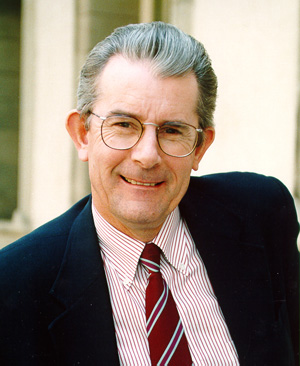
Research Summary - Christopher E. Brennen
Complex multiphase and multicomponent flows are a ubiquitous part of almost all existing and projected energy systems, and yet our understanding of these flows remains inadequate for many engineering purposes. In particular, our ability to predict the dynamic characteristics of multiphase flows or their behavior at high concentrations is very limited. Current research is focused on several of these fundamental issues. One such project is directed at improved understanding of the dynamics and acoustics of cavitation. Specific projects include: (1) studies of the interactions between cavitation bubbles and the flow and the implications for cavitation noise and damage (2) the population dynamics of cavitation nuclei of microbubbles and the relation to cavitation event rates (3) studies of the dynamics and acoustics of clouds of cavitation bubbles.
Other current research on multiphase flow includes studies of granular material flow and the behavior of other concentrated suspensions such as occur in fluidized beds. The granular material flow research is described elsewhere (see Professor M. L. Hunt); a current focus is a study of the effects of imposed vibration on granular material flows and the potential use of such vibration in industry. In both this project and in another study of unsteady motions in fluidized beds there is an ongoing effort to develop instrumentation to make measurements of particle motions in dense media.
Another important research activity is our effort to understand the instabilities and unsteady flows that limit the design and operation of modern, high-speed turbomachines. Cavitation, which is inevitable in many pumps, provides one set of severe problems, and our laboratory was the first to measure the dynamic transfer function for a cavitating pump. More recent projects have included studies of the unsteady flows and forces due to rotor/stator interaction, and a substantial body of experimental work on rotordynamic flows and forces.
Last updated 7/13/98.
Christopher E. Brennen, brennen@ccosun.caltech.edu